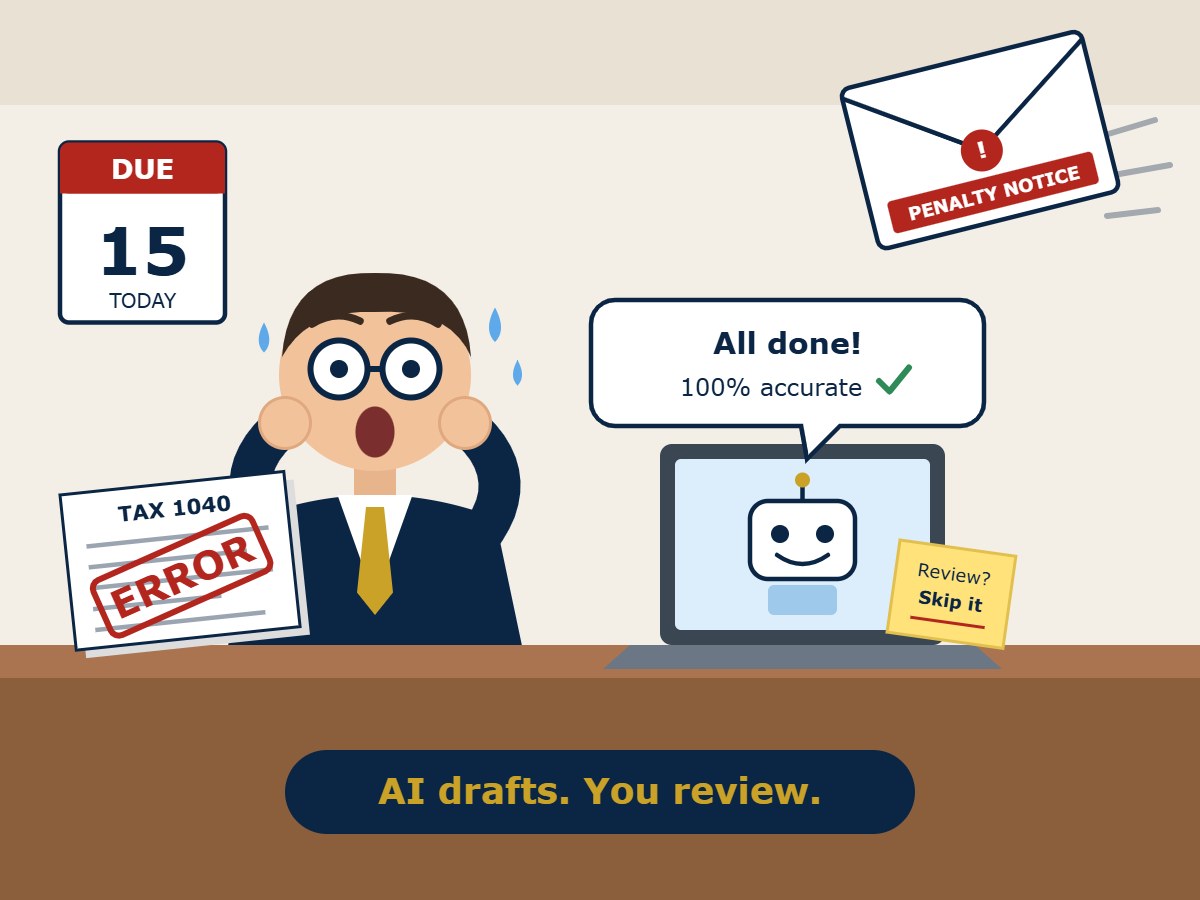
If you run a small business or a professional practice, someone on your team is probably already using ChatGPT, Claude, Copilot or Gemini — whether or not you have a policy for it. A June 2026 U.S. Chamber of Commerce Foundation survey found that about half of small business workers now use AI for work tasks. In my own profession the number is higher: Intuit’s 2026 survey found that 88% of U.S. accounting professionals used AI for at least one client service in the past year.
I use it too. Here is where it earns its keep, where it can get you in trouble, and what I would put in place before relying on it.
Where AI actually helps
I use AI to review documents — financial reports, lease agreements and other contracts. For our SEC reporting clients, it helps me review 10-K and 10-Q drafts and tie the numbers back to the supporting workbooks and QuickBooks Online. It does a good first pass: pulling renewal dates, rent escalations and who pays for what out of a lease, or flagging where a note in a filing doesn’t agree with the financial statements. It turns hours of reading and ticking into a short list of questions.
It is still a first pass. I read the document myself and confirm every tie-out. The AI points me to where to look; the judgment on what it means stays with me.
I also use it to build presentations and to draft emails that explain technical matters — an accounting standard, a tax change, a filing requirement — in language a client can follow. That alone saves me a lot of time.
Other good uses: summarizing long email threads, first drafts of policies and brainstorming marketing ideas.
Pitfall 1: It makes things up — confidently
AI tools are built to produce text that sounds right, and that is different from text that is right. They can invent a court case, an IRS ruling or a deduction limit and present it with complete confidence.
Lawyers have learned this the hard way. In June 2026 a federal judge in Mississippi sanctioned attorneys on both sides of the same case for filings with AI-invented citations and barred them from appearing in that court for two years. One public tracker counts more than 360 U.S. decisions involving lawyers and fabricated AI citations so far in 2026, up from 14 in 2024.
The same thing can happen with a tax position, a contract clause or a number in a board report. If it matters, check it against the original source.
Pitfall 2: Your data goes somewhere
When you paste information into a free AI tool, it leaves your control. Some public tools use what you type to train future models, and a promise not to train on your data is not the same as a promise not to keep it.
For most businesses, that means customer lists, employee records, Social Security numbers, bank details and anything covered by an NDA should stay out of free consumer tools. Public companies have one more reason for care: a 10-K or 10-Q draft before it is filed is material nonpublic information, and it belongs only in tools the company has approved.
For tax preparers the stakes are higher. Section 7216 of the Internal Revenue Code makes it a crime for a preparer to disclose or use return information for anything other than preparing the return without the client’s written consent. There is no IRS safe harbor for AI tools, and a general clause in an engagement letter is not a substitute for a proper consent. Tax and accounting practices are also treated as “financial institutions” under the FTC Safeguards Rule, regardless of size, and must keep a written information security plan that covers their outside vendors — AI tools included.
What the IRS now expects
On June 24, 2026, the IRS Office of Professional Responsibility issued its first guidance on AI in tax practice (OPR Alert 2026-19). The short version: there is no new rulebook. The existing Circular 230 duties — due diligence, competence, confidentiality and firm procedures — apply to AI-assisted work the same way they apply to everything else.
A few points stand out:
- The practitioner is fully responsible for work produced with AI help. If you sign it, you own it.
- Client data should go only into secure, approved systems.
- Firms need written AI policies and staff training.
- AI use should be disclosed as appropriate, and cost savings should be fairly reflected in what clients pay.
If you hire a tax preparer, these are fair questions to ask.
Pitfall 3: AI used against you
The same technology is in the hands of fraudsters. A cloned voice of the owner or CFO calls the bookkeeper: there is an urgent wire, a new vendor account, keep it quiet. FinCEN has warned financial institutions about deepfake schemes, and small businesses are attractive targets because one phone call from the owner is often all it takes to move money.
The best defense is a simple procedure — a callback rule. Any payment request, change to banking details or unusual transfer gets verified by calling back on a number you already have, never the one in the message.
A note for Texas businesses: the Texas Responsible Artificial Intelligence Governance Act took effect January 1, 2026. It is enforced by the Attorney General and places limited direct obligations on most private businesses, but it is worth knowing it is there.
What to do — seven steps
- Keep sensitive data out of free tools. No Social Security numbers, client files, bank details or anything under an NDA.
- Check the settings. Use business plans where available and turn off model training.
- Verify before you rely. Check every figure, citation and tax or legal rule against the original source.
- Write a one-page AI policy. Which tools are approved, what data can go in and who reviews the output.
- Add AI vendors to your security plan. If you handle client financial or tax data, your written security plan should cover them.
- Adopt a callback rule for every payment or banking change.
- Ask your advisors how they use AI. A good answer covers which tools, what data and who reviews the work.
How we use it
At JV Financial Services, AI is a drafting and review tool. It helps me get through documents faster and spot what deserves a closer look. It does not make judgments for our clients, and nothing goes out without my review. This article was drafted with AI assistance and reviewed and edited by me.
If you would like help putting an AI policy in place or reviewing how your business handles sensitive data, call us at (713) 389-8042 or email [email protected].
Sources
- IRS Office of Professional Responsibility, Alert 2026-19
- The Tax Adviser — IRS outlines AI risks, Circular 230 duties
- CPA Practice Advisor — What to settle before client tax data touches AI
- IRS — Written Information Security Plan reminder
- U.S. Chamber of Commerce Foundation — Main Street AI Monitor
- CPA Practice Advisor — 2026 Accountant Technology Survey
- Bloomberg Law — Lawyers on both sides sanctioned for AI errors
- AI Hallucination Sanctions Tracker
- Haynes Boone — Texas Responsible AI Governance Act
General information only, not individualized tax, legal or investment advice. Jorge L. Verar is a licensed CPA; JV Financial Services LLC is not a CPA firm and its services are not regulated by the Texas State Board of Public Accountancy. See our full disclosures.