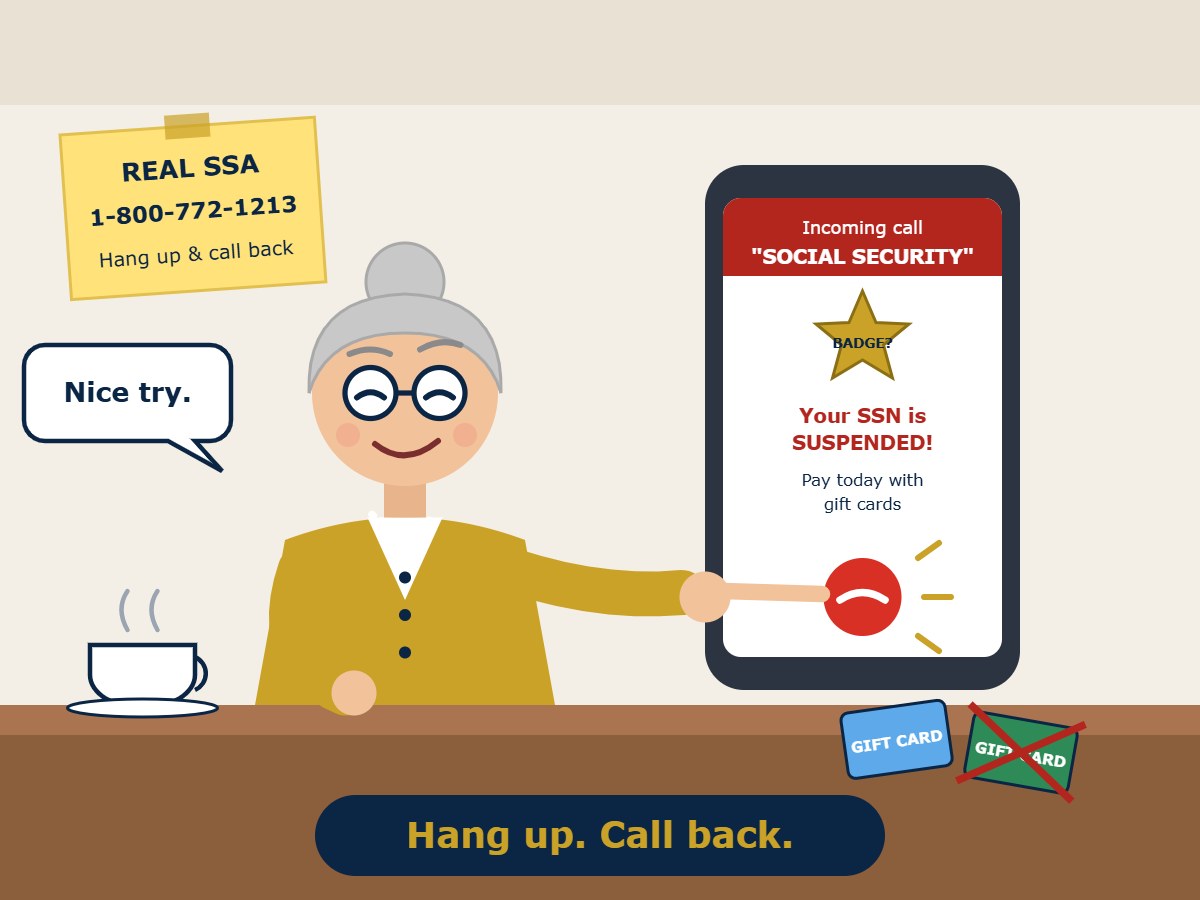
The call sounds official. The caller gives a name and a badge number, and may even text you a photo of the badge. Your caller ID says “Social Security.” There is a problem with your Social Security number, and you need to act today.
It is a scam, and it is costing older Americans more every year.
The numbers
Americans age 60 and older filed more than 201,000 complaints with the FBI’s Internet Crime Complaint Center in 2025 and reported $7.75 billion in losses, up 59% from the year before. Government impersonation complaints nearly doubled.
The Federal Trade Commission sees the same pattern. Most older adults who report a scam lose nothing, but those who do lose often lose a lot: reports of $100,000 or more were only 6% of older adults’ loss reports in 2025, yet they made up 70% of the dollars lost. And most fraud is never reported at all.
How the scam works in 2026
The old robocall saying your Social Security number has been “suspended” is still around. The newer versions are more convincing:
- Real names and fake badges. In April, the Social Security Office of the Inspector General warned that criminals are using the names of real SSA and Inspector General employees, sending doctored badge photos and setting up fake social media profiles.
- Spoofed caller ID. The number on your screen can be made to look like a government office.
- Fake “statement” emails. Emails with Social Security logos invite you to download your benefit statement. The link leads to a fake site or installs malware. Real Social Security email comes from an address ending in .gov.
- “Let me verify your records.” An impostor offers to check your employment record, or whether someone misused your number, if you will just confirm your Social Security number.
Once they have your information or your money, they move fast. They ask for gift cards, wire transfers, cryptocurrency, cash, even gold bars, because those are hard to trace and nearly impossible to get back.
The four red flags
Social Security lists four signs of a scam. If you see any one of them, stop:
- Someone claims to be from an agency or company you know.
- They say there is a problem, or a prize.
- They pressure you to act right now.
- They tell you to pay in a specific way.
What Social Security will never do
Real Social Security employees will never:
- Threaten you with arrest or legal action
- Suspend your Social Security number
- Threaten to seize your bank account
- Call out of the blue asking for your Social Security number or bank details
- Ask you to keep the call secret
- Ask for payment by gift card, prepaid card, wire transfer, cryptocurrency or cash by mail
- Send you a photo of a badge to prove who they are
If you really owe Social Security money, you will get a letter in the mail explaining your payment options and your appeal rights.
Five steps to protect yourself
- Open your own my Social Security account at ssa.gov/myaccount. Scammers have opened accounts in other people’s names and redirected their benefits. If the account is already yours, they can’t. Check your earnings record and payment details while you are there.
- Hang up and call back. If a call worries you, hang up and call Social Security directly at 1-800-772-1213. Never use a number the caller gives you.
- Never pay by gift card, cryptocurrency, gold or wire. No government agency collects money that way.
- Talk to someone before you act. Scammers tell you to keep it secret because a second opinion ends the scam. Call a family member or your advisor first.
- Turn on bank alerts. Ask your bank to text or email you for large withdrawals and transfers.
Already shared something?
Don’t be embarrassed. These are professional criminals, and they fool smart people every day. Act quickly:
- Stop all contact and write down what you shared and when.
- Report it to the Social Security Inspector General at oig.ssa.gov/report.
- File a report at IdentityTheft.gov to get a recovery plan.
- Place a fraud alert or credit freeze with Equifax, Experian and TransUnion.
- Call your bank if you sent money or gave account details.
- You can also report to ReportFraud.ftc.gov and IC3.gov.
Be wary of anyone who then offers to “recover” your money for a fee. Recovery scams cost seniors about $540 million in 2025.
A word to adult children
If your parents are retired, have this conversation now, before the call comes. Help them set up their my Social Security account, put the 1-800 number on the refrigerator, and agree on one simple rule: no money goes to anyone who called first until the family has talked about it.
If something doesn’t look right — a letter, a call, a change on a statement — call us at (713) 389-8042 or email [email protected]. We are happy to take a look.
Sources
- SSA Office of the Inspector General — New wave of imposter scams (April 2026)
- SSA Office of the Inspector General — Protect your Social Security number (August 2026)
- Social Security — Scam awareness
- FTC — Protecting Older Consumers report to Congress
- AARP — FBI and FTC 2025 fraud data
- HousingWire — FBI data on seniors and cybercrime in 2025
General information only, not individualized tax, legal or investment advice. Jorge L. Verar is a licensed CPA; JV Financial Services LLC is not a CPA firm and its services are not regulated by the Texas State Board of Public Accountancy. See our full disclosures.